GROWING
"For everything there is a season, and a time for every matter under heaven." — Ecclesiastes 3:1
Summer Doesn't Last Forever
Here in Maine, we can usually sense autumn before it actually arrives. The evenings become a little cooler. Daylight disappears a little earlier. A few leaves begin changing color while everything around them is still green. Summer hasn't quite ended, but something is changing.
Our lives have seasons too. There are seasons when faith seems almost effortless—when prayer comes easily, Scripture seems alive, and we sense that God is doing something new. There are other seasons when faith requires perseverance.
- Sometimes we are growing.
- Sometimes waiting.
- Sometimes celebrating.
- Sometimes grieving.
- Sometimes beginning something completely new.
- And sometimes God asks us to let go of something that was once very important to us.
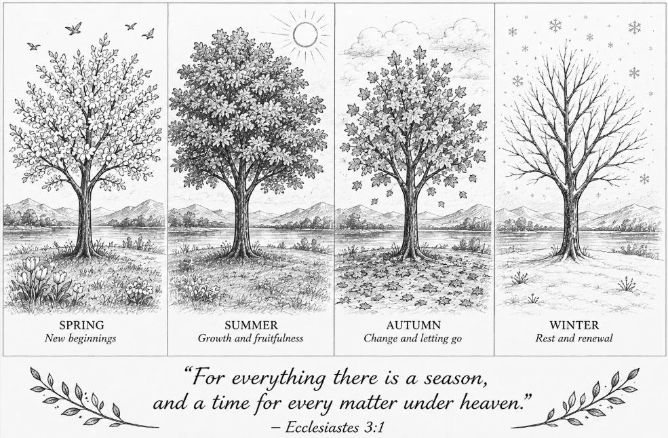
Ecclesiastes reminds us:
"For everything there is a season, and a time for every matter under heaven."
(Ecclesiastes 3:1)
The important question is not whether seasons will change. They will.
The better question is:
What might God be doing in this season of my life?
Our Spiritual Season Is Not Determined by Our Age
We often associate seasons of life with age. Spring belongs to the young. Summer represents adulthood and productivity. Autumn suggests maturity. Winter represents old age. It is a beautiful metaphor—but spiritually, it can be misleading. God does not follow our calendar.
Moses was about eighty when God called him to confront Pharaoh. Abraham was seventy-five when God told him to leave his homeland and begin a new journey. Caleb was eighty-five when he essentially said, I'm still ready—give me the mountain! (Joshua 14:10–12).
Timothy was young enough that Paul had to remind him:
"Let no one despise your youth." (1 Timothy 4:12)
God can begin something new at twenty. Or forty. Or sixty. Or eighty.
We should be careful about deciding that a particular season of usefulness, learning, creativity, service, or spiritual growth has passed simply because another birthday has arrived. As long as Christ is still shaping us, there is another season ahead.
Not Every Season Feels Like Growth
There is another lesson in nature worth remembering. Trees do not look particularly productive in January. There are no leaves. No blossoms. No visible fruit. Yet the tree is not dead. Beneath the surface, life remains. Christian growth can be like that.
There may be seasons when we don't feel particularly close to God. Prayer may seem harder. Circumstances may change. A relationship may end. Health may alter what we can do. Children leave home. Work ends. Retirement begins. Someone we love dies. A ministry we once enjoyed may no longer be ours to carry.
We may wonder:
What is God doing now?
Sometimes we will know. Sometimes we won't. Faith means trusting that God remains present even when growth is not immediately visible. Jesus said:
"My Father is the vinegrower... every branch that bears fruit he prunes to make it bear more fruit." (John 15:1–2)
Even pruning has a purpose. Sometimes God removes. Sometimes He redirects. Sometimes He asks us simply to wait. And sometimes, after a long winter, He surprises us with spring.
What Can We Learn from Church History?
Few Christians experienced changing seasons more dramatically than Augustine of Hippo. As a young man in the fourth century, Augustine was ambitious, intellectually restless, and uncertain about Christianity. He pursued education, career, philosophy, relationships, and different explanations for life's deep questions.
His mother, Monica, continued praying for him. Eventually Augustine's searching brought him back toward Christianity. In A.D. 386, during an intense period of spiritual struggle, he heard a child's voice repeating words commonly translated as:
"Take up and read."
Augustine opened Paul's writings and encountered Romans 13:13–14. That moment became part of the turning point that led to his conversion, but conversion was not the end of Augustine's story. It began another season. He became a priest. Then a bishop. Then one of the most influential Christian thinkers in Church history. Late in his life, another season arrived. The Roman world Augustine had known was changing dramatically. In A.D. 410, Rome itself was sacked. Near the end of Augustine's life, invading Vandals surrounded Hippo while the aging bishop remained with his people.
The world around him was changing. Augustine was changing, but Christ had not changed. That may be one of Church history's quiet lessons:
Faithfulness does not require every season to look the same.
From the Church Archives
Augustine: Faithful Through Changing Times
A.D. 354–430
Augustine's life contained remarkably different seasons: ambitious student, restless seeker, Christian convert, priest, bishop, theologian, and finally an aging pastor watching the Roman world in enormous upheaval.
His circumstances changed repeatedly, but his desire to understand and follow God continued to deepen.
Why it matters: No season of life places us beyond God's ability to teach, redirect, or use us. A changing season does not mean God has finished with us. Sometimes it means He is preparing us for what comes next.
Living It Today
Perhaps we should occasionally ask ourselves: What season am I in right now?
Maybe this is a season for learning. Perhaps it is a season for serving. Perhaps for mentoring someone younger. Perhaps for trying something completely new. Perhaps for creating—writing a poem, painting a picture, learning music, building something, or discovering a gift we never knew we possessed. Perhaps it is a season for healing; perhaps for waiting; perhaps for becoming more attentive to God.
Our church has seasons too. A small congregation may enjoy the closeness of knowing nearly everyone in the room. Then God may bring new people. That changes things.
We should welcome the new season without losing what was beautiful about the old one. We can grow and remain a family. We can welcome new people and continue noticing when someone is missing. We can try new things and remain anchored in God's Word.
The goal is not to preserve one season forever. The goal is to remain faithful to Christ in every season.
For Further Reading
In Scripture
- Ecclesiastes 3:1–8 — A season for everything
- Isaiah 40:28–31 — Renewed strength
- Philippians 3:12–14 — Continuing to press forward
From the Early Church
- Augustine, Confessions, Book VIII — Augustine's account of the events of his conversion
- Augustine, The City of God — written as Christians wrestled with the upheaval in the Roman world
Recommended Books
- Henry Chadwick, Augustine: A Very Short Introduction — an accessible introduction to Augustine's life and thought
- Peter Brown, Augustine of Hippo: A Biography — a classic modern biography
- Justo L. González, The Story of Christianity, Volume 1 — helpful context for Augustine and Christianity in the late Roman world
Faith Through the Ages Timeline
This article connects biblical teaching about the changing seasons of life with Augustine and the late Imperial Church.
○ Apostolic Church (A.D. 30–100)
○ Apostolic Fathers (A.D. 70–150)
○ Ante-Nicene Church (A.D. 150–325)
✓ Imperial Church (A.D. 325–590)
○ Early Medieval Church (A.D. 590–1054)
○ High Middle Ages (A.D. 1054–1517)
○ Reformation (A.D. 1517–1648)
○ Evangelical Awakenings (A.D. 1648–1900)
○ Modern Church (A.D. 1900–Present)
Reflection
As summer gives way to autumn, take a moment to consider your own life. What season are you in? And perhaps more importantly: What might God be asking of you in this season? Don't assume you are too young. Don't assume you are too old. Don't assume that because something has ended, your most meaningful season is behind you. The leaves that fall in autumn are not evidence that the tree has failed. They are simply evidence that the season is changing. May we have the wisdom to recognize the season God has given us, the courage to release what belongs to the season that is passing, and the faith to discover what Christ may be preparing next. Because whatever our age, there is still more of Jesus to know—and still more ways for Him to use us.
Our Commitment to Faithful Adherence to God's Word
We seek to present Scripture as the final authority for faith and practice while drawing upon the best available historical scholarship to help readers understand how Christians have interpreted and lived out biblical truth throughout the centuries. Historical sources illuminate the Church's witness but never supersede the authority of God's Word