SERVING
"Whatever you do, work at it with all your heart, as working for the Lord, not for human masters."
(Colossians 3:23)
What Counts as Work?
Labor Day marks the unofficial end of summer.
For some of us, it brings memories of years spent working at jobs we loved—or perhaps jobs we simply endured because bills had to be paid. Others are still working full-time. Some are retired. Some volunteer. Some care for homes, spouses, grandchildren, friends, or neighbors.
But Scripture invites us to think about labor more broadly.
What actually counts as work in God's eyes?
Our culture usually connects work with employment. We have a job, receive a paycheck, build a career, and eventually retire. The Bible presents a larger picture. Long before sin entered the world, God placed Adam in the garden "to till it and keep it" (Genesis 2:15). Work was not originally a punishment. Human beings were created to cultivate, create, tend, build, and care for what God had entrusted to them.
Sin made labor difficult. Genesis speaks of thorns, sweat, frustration, and toil, but work itself remained good. That means our work for God does not necessarily end when our employment does.
Whatever You Do
Paul gives the Colossians a remarkable instruction:
"Whatever you do, work at it with all your heart, as working for the Lord..."
(Colossians 3:23)
“Whatever you do.” That makes the circle surprisingly large. Preparing a meal can become Christian work. Teaching a child can become Christian work. Painting a picture can become Christian work. Mowing someone's lawn can become Christian work. Making music can become Christian work. Sitting with someone who is lonely can become Christian work. So can earning a living, running a business, fixing an engine, balancing accounts, cleaning a room, teaching a class, or caring for someone who can no longer care completely for himself or herself. The task does not have to be performed inside a church building to belong to God.
Perhaps the better question is not:
"Is this religious work?"
But:
"Can I do this faithfully, lovingly, and for the glory of God?"
Jesus Knew Work
We sometimes forget that before Jesus began His public ministry, He spent most of His earthly life doing ordinary work. The people of Nazareth knew Him as the tekton (Mark 6:3)—a Greek word traditionally translated "carpenter," though it can refer more broadly to a craftsman or builder. Imagine that!
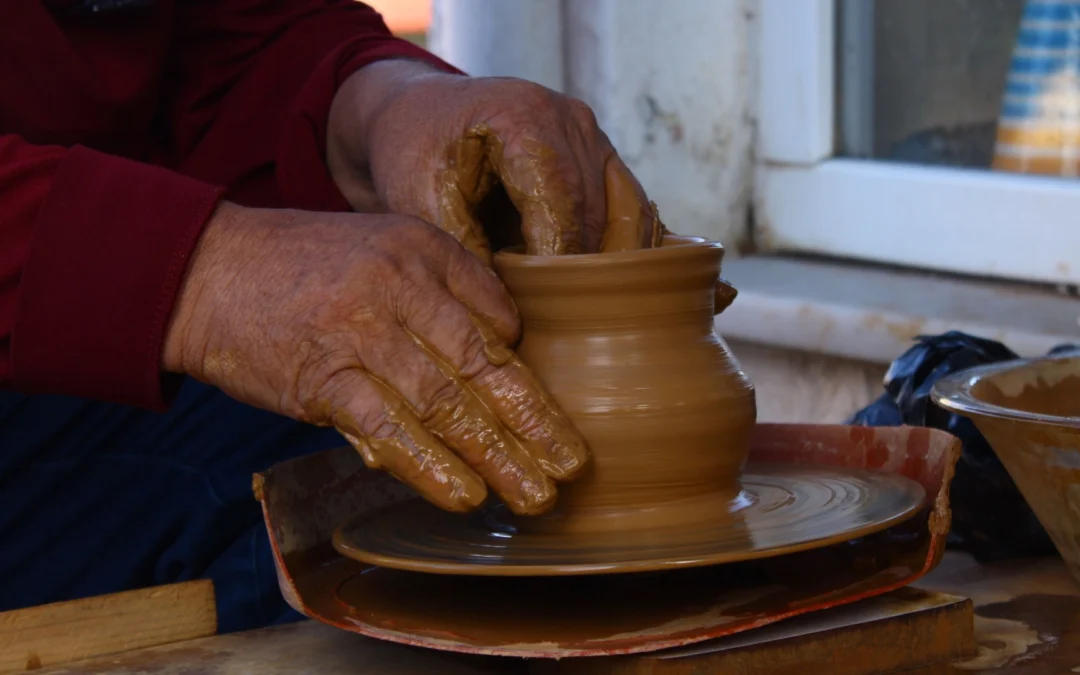
… The hands that would eventually break bread at the Last Supper had handled tools.
… The hands that would touch the sick and wash the disciples' feet had known ordinary labor.
… The hands eventually stretched upon the cross had spent years making and repairing things.
There is something profoundly reassuring about that. Jesus understands ordinary work.
What Can We Learn from Church History?
More than five hundred years after Christ, Benedict of Nursia established a community at Monte Cassino in Italy. His Rule of Saint Benedict, written in the sixth century, helped shape Christian monastic life for centuries. Benedict organized daily life around prayer, Scripture, community, hospitality, and work. For example …
… Monks worked in kitchens.
… They tended fields.
… They cared for buildings.
… They welcomed strangers.
… They copied manuscripts.
… They performed the ordinary tasks required to sustain a community.
… Later generations summarized Benedictine spirituality with the Latin expression:
Ora et labora — "Pray and work."
The phrase itself does not appear in Benedict's Rule, but it captures something important about the life he envisioned. Prayer and work were not competing parts of Christian life.
Both could belong to God.
That insight eventually had enormous consequences. Monastic communities became places not only of prayer but also of agriculture, learning, hospitality, craftsmanship, manuscript preservation, and care for travelers and the poor. Much of the work was ordinary, but ordinary work, faithfully offered, could become an act of devotion.
From the Church Archives
Benedict of Nursia and the Dignity of Ordinary Work
Approximately A.D. 480–547
Benedict organized monastic life around worship, Scripture, community, hospitality, and practical labor. His Rule instructed members of the community to share responsibility for everyday work rather than viewing physical labor as beneath spiritual life.
Over time, Benedictine communities became associated with the principle later summarized as ora et labora—"pray and work."
Benedict’s legacy reminds us that everyday labor, when offered faithfully and humbly to God, can become an important part of our spiritual life.
Why it matters: Christian service is not limited to explicitly "religious" activities. Ordinary work—performed faithfully, humbly, and for the good of others—can itself become an offering to God.
The Work Nobody Sees
This may be particularly important in a small church. A church family survives on a remarkable amount of work that is rarely voiced Sunday morning on Cottage Road.
Someone unlocks the door.Someone turns on the lights.Someone practices a song or a guitar or a violin.Someone prepares coffee.Someone cleans up afterward.Someone calls the person who hasn't been there lately.Someone brings food to a neighbor.Someone quietly gives money when another person needs help.Someone prays during the week for a request mentioned Sunday morning.Someone paints, writes a poem, repairs something, moves a chair, sends a card, or simplyarrives early enough to greet someone who needs a friendly face.
Most of it will never receive applause. That doesn't make it less important. On the contrary, Jesus said that even giving "a cup of cold water" in His name matters to God (Matthew 10:42). The Kingdom of God is built through an extraordinary number of ordinary acts of faithfulness.
There Is No Retirement from Christian Service
Labor Day also gives us an opportunity to reconsider retirement. Retirement from employment can be a wonderful and well-earned season of life, but Christians never really retire from loving, growing, giving, and serving. The form of our labor may change.
Someone who once led may now encourage.Someone who once worked long hours may now have time to visit.Someone whose physical strength has diminished may have accumulated decades of wisdom.Someone who cannot do what he or she once did may have more time to pray.And someone who believes the most productive years are behind them may discover that God hasan entirely different kind of work ahead.
That connects with our recent reflection on changing seasons. A different season does not mean an unproductive season. Sometimes God simply changes the work.
Living It Today
In Scripture
- Genesis 2:15 — Work in God's good creation
- Mark 6:1–3 — Jesus the craftsman
- Colossians 3:22–24 — Working wholeheartedly for the Lord
- 1 Thessalonians 4:9–12 — Faithfulness in ordinary work
- Matthew 25:14–30 — Faithfully using what God entrusts to us
From the Early Church
- The Rule of Saint Benedict, especially Chapters 48 and 53 – manual labor, daily life, and hospitality
- John Cassian, The Institutes — an earlier influence on Western monastic life and discipline
Recommended Books
- Henry Chadwick, The Early Church — useful background for the Christian world
- Justo L. González, The Story of Christianity, Volume 1 — accessible historical context for Christianity in late antiquity and the early Middle Ages
- Benedict of Nursia, The Rule of Saint Benedict — short, remarkably accessible, and worth reading directly
Faith Through the Ages Timeline
This article connects the biblical dignity of work with the development of Christian community and labor in the early monastic tradition.
○ Apostolic Church (A.D. 30–100)
○ Apostolic Fathers (A.D. 70–150)
○ Ante-Nicene Church (A.D. 150–325)
✓ Imperial Church (A.D. 325–590)
✓ Early Medieval Church (A.D. 590–1054)
○ High Middle Ages (A.D. 1054–1517)
○ Reformation (A.D. 1517–1648)
○ Evangelical Awakenings (A.D. 1648–1900)
○ Modern Church (A.D. 1900–Present)
Reflection
This Labor Day, perhaps the most important question is not: "What do I do for a living?"
It is: "What has God given me to do?"
The answer may involve a career, but it may also involve a neighbor, a spouse, a grandchild, a paintbrush, a musical instrument, a kitchen, a telephone, a prayer list—or a small church family that needs precisely the gift God has placed in your hands.
Our jobs eventually end.
Our abilities change.
Our seasons change.
But the opportunity to offer something to Christ remains. May the prayer of Psalm 90 become ours:
"Let the favor of the Lord our God be upon us, and prosper for us the work of our hands."
Whatever work God has placed before us, may we do it well for Him and with love.
Our Commitment to Faithful Adherence to God's Word
We seek to present Scripture as the final authority for faith and practice while drawing upon the best available historical scholarship to help readers understand how Christians have interpreted and lived out biblical truth throughout the centuries. Historical sources illuminate the Church's witness but never supersede the authority of God's Word.