
Living by Faith — Part One of Three
GROWING
“For in it the righteousness of God is revealed through faith for faith; as it is written, ‘The one who is
righteous will live by faith.’” — Romans 1:17
What Does It Mean to Live by Faith?
Most of us have heard the expression living by faith. We use it when someone is facing an uncertain future, trusting God through a difficult illness, or making a decision without knowing exactly how things will turn out. Sometimes we associate it with extraordinary courage—the missionary who leaves everything behind, the Christian who faces persecution, or the person who takes an enormous risk because of a deeply held conviction.
Those certainly can be examples of faith. But when the Apostle Paul writes about living by faith in Romans, he begins somewhere even more fundamental. Before faith becomes a way of living, it is the means by which we enter into a right relationship with God.
Paul's letter to the Romans was written around A.D. 57, probably while he was in Corinth. He was addressing Christians in the capital of the Roman Empire, a community that included believers from both Jewish and Gentile backgrounds. These Christians had different histories, religious experiences, and understandings of God's law. Paul wanted them to understand something that transcended those differences:
no one earns a right relationship with God through personal achievement. Salvation is God's gift,
received through faith in Jesus Christ.
That truth sounds familiar to us today. Yet throughout Christian history, understanding its full implications has sometimes been surprisingly difficult.
The Problem with Trying to Be Good Enough
We live in a world that measures accomplishment. We work hard, earn credentials, develop skills, and hope that our efforts produce something worthwhile. Most of the time, that is perfectly reasonable. If we want to become better musicians, gardeners, teachers, or craftspeople, we practice. If we want to improve our homes, we invest time and energy.
But what happens when we bring that same thinking into our relationship with God?
We may begin to imagine that God accepts us because we attend church, give generously, help our neighbors, read Scripture, or generally behave better than other people. Those are all potentially wonderful expressions of Christian faith, but Paul insists that none of them can serve as the foundation of our salvation. In Romans 3:23–24, Paul writes that all have sinned and fall short of God's glory, yet are justified by His grace through the redemption found in Christ Jesus. Later, in Romans 5:1, he explains that because we are justified by faith, we have peace with God through Jesus Christ.
Notice the order. We do not first become good enough and then earn God's acceptance. We come to Christ in faith, receive God's grace, and begin the lifelong process of becoming more like Him.
That distinction changes everything.
A Troubled Monk in Germany
In the early sixteenth century, a young German monk named Martin Luther struggled intensely with questions about sin, righteousness, and his standing before God. Luther was not an indifferent Christian. He was extraordinarily serious about his Faith, sometimes painfully so. He prayed, confessed his sins,
studied Scripture, and sought assurance that he had done enough to satisfy God's demands.
Yet assurance remained elusive.
As Luther studied Romans, particularly Paul's teaching about the righteousness of God and justification by faith, he came to understand righteousness not merely as something God demands from sinful people, but as something God graciously grants through faith in Christ.
Luther later described this realization as a profound turning point in his understanding of the Gospel. Historians debate the precise timing of that discovery, but its theological importance is unmistakable. His developing convictions would help ignite the Protestant Reformation
after 1517.
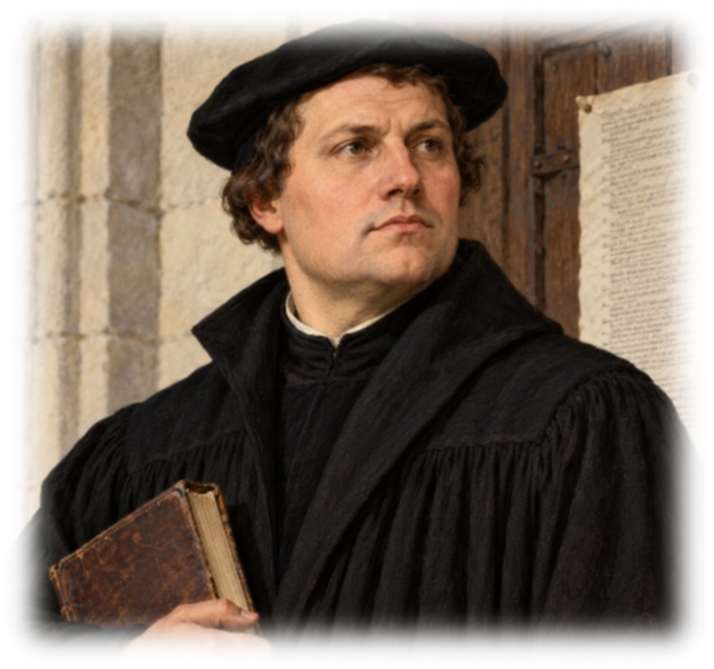
From the Church Archives
Martin Luther and the Discovery of Grace
A.D. 1483–1546
Martin Luther was a German monk,
theologian, and university professor
whose study of Scripture, especially Romans and Galatians, profoundly shaped the Protestant Reformation. His understanding of justification by faith challenged prevailing teachings and practices concerning salvation, repentance, and the authority of the Church.
Why it matters: Luther's struggle
reminds us that even sincere religious devotion can become spiritually burdensome when we lose sight of God's grace. The foundation of Christian faith is not our ability to make ourselves righteous, but Christ's saving work
on our behalf.
One of the Reformation's defining principles became sola fide—justification by faith alone. Luther did not invent Paul's teaching. He rediscovered its central importance for a Church whose practices and theological disputes had, in his judgment, obscured the Gospel's message of grace. For Luther, the question was deeply personal: How can a sinful person stand before a holy God?
Paul's answer was that our confidence rests not in our own righteousness, but in Jesus Christ.
Living It Today: Faith Is Not a Performance
Most of us are unlikely to experience Luther's particular struggles as a sixteenth-century monk, but we may recognize something of his anxiety. Perhaps we have wondered whether we pray enough, serve enough, give enough, or possess enough faith. We may compare ourselves with Christians who seem more spiritually mature, more knowledgeable about Scripture, or more confident in their relationship with God. Paul invites us to begin somewhere else.
Our relationship with God does not rest upon our ability to impress Him. It rests upon the grace He has extended to us through Jesus Christ. That doesn't make Christian obedience unimportant. Quite the opposite. When we understand that God's love is not something we must continually earn, we are freed to respond to that love with gratitude, trust, and obedience.
n a small church like Cornerstone, we may be especially aware of one another's gifts and contributions. Some people teach. Others sing, prepare meals, maintain the building, visit neighbors, or quietly pray for people throughout the week. All those activities matter, but none makes one Christian more deserving of God's grace than another.
We do not serve so that God will love us. We serve because He already has loved us in Christ.
… That is where living by faith begins …
For Further Reading
In Scripture: Romans 1:16–17; Romans 3:21–28; Romans 4:1–8; Romans 5:1–11; Ephesians 2:8–10.
From Church History: Martin Luther, Preface to the Letter of St. Paul to the Romans (1522); Luther's Preface to the Complete Edition of Luther's Latin Writings (1545), which recounts his developing understanding of righteousness and faith.
Recommended Books: Justo L. González, The Story of Christianity, Volume 2; Alister E. McGrath, Reformation Thought: An Introduction.
Faith Through the Ages Timeline
Historical focus: Reformation (A.D. 1517–1648)
Martin Luther's study of Romans helped shape the Protestant Reformation, particularly its emphasis on justification by faith. His theological insights emerged within a much longer history of Christian reflection on salvation, grace, and righteousness
- Apostolic Church (A.D. 30–100)
- Apostolic Fathers (A.D. 70–150)
- Ante-Nicene Church (A.D. 150–325)
- Imperial Church (A.D. 325–590)
- Early Medieval Church (A.D. 590–1054)
- High Middle Ages (A.D. 1054–1517)
- Reformation (A.D. 1517–1648)
- Evangelical Awakenings (A.D. 1648–1900)
- Modern Church (A.D. 1900–Present)
Reflection
Perhaps the most important question we can ask ourselves is not whether we have accomplished enough for God, but whether we have truly entrusted ourselves to Jesus Christ.
There is a wonderful freedom in recognizing that our spiritual journey does not begin with our achievements. It begins with God's grace. We come to Him with our weaknesses, failures, uncertainties, and hopes, trusting that Christ has accomplished what we could never accomplish for ourselves.
But this raises another question.
If faith brings us into a right relationship with God, what happens next?
Does faith simply change our standing before God, or should it also change the way we live?
That is where we will continue in Part Two.
Our Commitment to Faithful Adherence to God's Word
We seek to present Scripture as the final authority for faith and practice while drawing upon the best available historical scholarship to help readers understand how Christians have interpreted and lived out biblical truth throughout the centuries. Historical sources illuminate the Church's witness but never supersede the authority of God's Word.