
Living by Faith — Part Two of Three
GROWING & LOVING
“Do not be conformed to this world, but be transformed by the renewing of your minds.” — Romans 12:2
When Faith Begins to Change Us
In our previous blog, we considered Paul's teaching that we are justified by faith through God's grace, not through our own accomplishments. That is where our Christian journey begins. But if we stop there, we miss something equally important.
Faith is not merely something we believe about Jesus. It is a relationship with Him that gradually
changes who we are.
Imagine someone who has lived in the same house for forty years. Over time, the house becomes familiar. The furniture is arranged just so. There are habits associated with every room, and even a few things that haven't worked properly for years. The owner knows which door sticks, which window rattles, and which floorboard creaks. Now imagine that the house receives a new owner who intends to restore it. Some changes are immediate. Others take considerable time. A few require opening walls and discovering problems that have been hidden for decades. Our spiritual lives can be a little like that.
When we come to Christ, we don't arrive as blank slates. We bring our habits, assumptions, prejudices, disappointments, ambitions, fears, and memories. Some of those things are good. Others need to change. And sometimes the things most in need of transformation are the ones we have grown most comfortable living with. Paul understood this.
Grace Is Not Permission to Remain Unchanged
In Romans 6, Paul anticipates a question that naturally follows his teaching about grace: If God's grace is so abundant, does it matter whether we continue sinning?
His answer is emphatic: “By no means!” (Romans 6:2).
Paul explains that believers have been united with Christ in His death and resurrection. Consequently, their relationship to sin has fundamentally changed. Christians are no longer to regard sin as their rightful master. That does not mean believers instantly become perfect. Paul himself describes the continuing struggle with sin, and Romans 8 directs our attention to the transforming work of the Holy Spirit. In Romans 8:13–14, Paul teaches that those who live by the Spirit put to death the deeds of the body and are led by the Spirit of God. Later, in Romans 12:2, he calls believers to be transformed through the renewing of their minds.
This is an important distinction. Faith is not simply agreeing that Jesus is Lord while continuing to live as though nothing has changed. It means increasingly allowing His truth to reshape our thinking, priorities, relationships, and behavior.
… That process can be uncomfortable. …
A Man Who Refused to Be Silent
About a century before Martin Luther, a Czech preacher and reformer named John Hus confronted questions about faith, obedience, and the authority of Scripture. Hus lived in Bohemia, in what is now the Czech Republic, during the late fourteenth and early fifteenth centuries. Influenced in part by the writings of English reformer John Wycliffe, Hus became concerned about corruption within the Church and emphasized the importance of Scripture, moral integrity, and faithful Christian leadership. As a preacher in Prague's Bethlehem Chapel, Hus called Christians—and particularly Church leaders—to live in ways consistent with the Gospel they professed.
His convictions eventually brought him into conflict with ecclesiastical authorities. In 1415, after proceedings at the Council of Constance, Hus was condemned for heresy and executed by burning.
Hus was not a sixteenth-century Protestant, and it would be historically misleading to suggest that his theology was identical to Luther's. Nevertheless, his emphasis on Scripture and his willingness to challenge practices he believed contradicted Christian truth made him an important predecessor of the Reformation. Luther later recognized important similarities between some of Hus's positions and his own.
What makes Hus particularly relevant to our discussion is that he believed Christian convictions must have consequences for how we live—even when those consequences are costly. His story also reminds us that sincere conviction does not eliminate the need for humility, careful interpretation, or discernment. Christians must continually test their understanding against Scripture rather than assuming that the strength of a conviction automatically establishes its truth.
From the Church Archives
John Hus: Conviction and the Cost of Faith
c. A.D. 1372–1415
John Hus was a Bohemian priest,
preacher, and reformer who emphasized Scripture, Christian integrity, and the responsibility of Church leaders to live consistently
with the Gospel. His criticism of ecclesiastical corruption brought him into conflict with Church authorities, and he was executed following his condemnation at the Council of Constance in 1415. Why it matters: Hus reminds us that faith involves more than intellectual agreement. Christian convictions should shape our conduct and decisions, while remaining subject to the authority of Scripture and the discipline of humble discernment.
The Quiet Work of Transformation
1Most of us will never face anything resembling the circumstances confronted by Hus. Our opportunities to live faithfully are usually much less dramatic. We might discover that we have become impatient with someone we love. Perhaps we have held onto an old grievance, spoken
carelessly about another person, or allowed our opinions to become more important than our relationships. Sometimes our greatest spiritual challenges are not public controversies. They are the private habits we have stopped
questioning.
Paul's instruction in Romans 12:2 is particularly helpful because it places transformation in the context of the mind.
The way we think influences the way we act. Our assumptions shape our responses, and our priorities determine what receives our attention.
That means spiritual growth involves more than avoiding obvious wrongdoing. It also requires learning to examine the way we interpret the world around us. When something irritates us, do we immediately assume the worst? When someone disagrees, do we listen or prepare our defense? When Scripture challenges a familiar belief, are we willing to reconsider it? When we recognize that we have hurt someone, can we apologize without first explaining why we were justified?
These are not glamorous spiritual achievements. But they may reveal some of the most meaningful ways the Holy Spirit is renewing our minds.
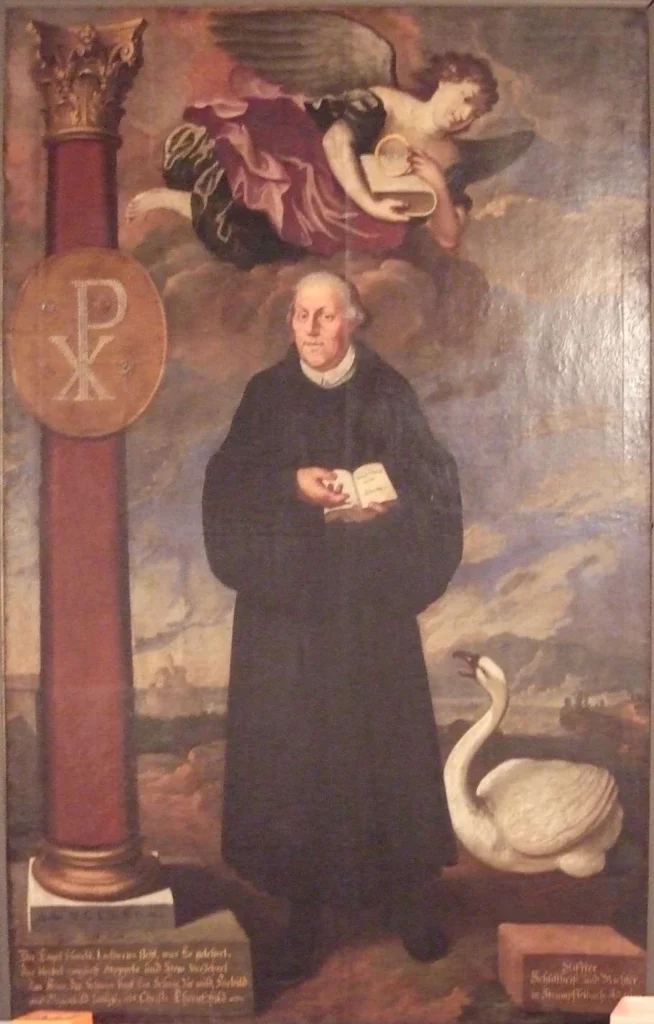
1 Martin Luther with a Swan (1698), attributed to J. A. List, in St. Jodokus Church, Strümpfelbach, Germany. Notice the white swan near Luther's feet. It represents the tradition connecting Luther to John Hus and the legendary prediction that a swan would follow the goose.
A Supplemental Story About John Hus
The Goose and the Swan: A Story That Outlived John Hus
On July 6, 1415, John Hus was led to his execution outside the German city of Constance. Condemned for heresy by the Council of Constance, the Bohemian preacher had refused to abandon convictions he believed were grounded in Scripture. His surname, Hus, meant “goose” in the Czech language, a coincidence that would eventually give rise to one of the most memorable stories in Reformation history.
According to a tradition that developed after his death, Hus addressed those preparing to burn him with a remarkable prediction: “Today you burn a goose, but in a hundred years a swan will arise whom you will not be able to silence.” Although historians have found no reliable contemporary evidence that Hus actually spoke those words, the story captured something important about his legacy. Hus had expressed confidence that others would continue defending the truths for which he was willing to die. The image of the goose and the swan became a powerful symbol of that expectation.
Just over a century later, in 1517, Martin Luther published his Ninety-Five Theses, challenging the sale of indulgences and beginning a controversy that would help ignite the Protestant Reformation. As Luther studied Hus's writings, he discovered similarities between their concerns about Church authority, Scripture, and reform. Luther eventually embraced the goose-and-swan tradition, interpreting himself as the swan who had followed Hus. By 1531, he was explicitly applying the story to his own ministry.
Whether or not Hus ever spoke the famous prediction, the historical connection is genuine. A preacher who died in 1415 helped influence a reformer whose work would transform European Christianity a century later. Neither man could fully foresee the consequences of his convictions, yet each became part of a much larger story.
Perhaps that is one of the most encouraging lessons about living by faith: We may never know how God will use our faithfulness—or whose life may be influenced by the convictions we courageously live out today.
Living It Today: Becoming More Like Jesus
Our church family has spent considerable time discussing growth. We have considered ways to welcome new people, strengthen our fellowship, and become more visible in the community. Those are worthwhile goals, but perhaps we should occasionally ask another question.
Are we growing spiritually as well as numerically?
A church can add members without necessarily becoming more loving. It can develop new ministries without becoming more generous. It can become busier without becoming more prayerful.
The opposite is also true. A small congregation can demonstrate remarkable spiritual maturity through patience, hospitality, forgiveness, humility, and a willingness to serve.
Perhaps one of the greatest gifts we can offer someone visiting our church is not simply a friendly greeting, although that matters enormously. It is the opportunity to encounter people whose lives are genuinely being changed by Jesus Christ.
That kind of transformation cannot be manufactured through programs or publicity. It develops as individual Christians respond to God's Word and the leading of the Holy Spirit.
Living by faith means allowing the Christ we believe in to change the people we are becoming.
For Further Reading
In Scripture: Romans 6:1–14; Romans 8:1–17; Romans 12:1–2; Galatians 5:16–25; Ephesians 4:22–32.
From Church History: John Hus, On the Church (De Ecclesia); selected sermons and letters written during
his imprisonment.
Recommended Books: Thomas A. Fudge, Jan Hus: Religious Reform and Social Revolution in Bohemia;
Justo L. González, The Story of Christianity, Volume 1.
Faith Through the Ages Timeline
Historical focus: High Middle Ages (A.D. 1054–1517)
John Hus lived during the closing century of the medieval Church. His emphasis on Scripture, Christian
integrity, and reform anticipated several concerns that would become prominent during the Protestant
Reformation a century later.
- Apostolic Church (A.D. 30–100)
- Apostolic Fathers (A.D. 70–150)
- Ante-Nicene Church (A.D. 150–325)
- Imperial Church (A.D. 325–590)
- Early Medieval Church (A.D. 590–1054)
- High Middle Ages (A.D. 1054–1517)
- Reformaon (A.D. 1517–1648)
- Evangelical Awakenings (A.D. 1648–1900)
- Modern Church (A.D. 1900–Present)
Reflection
Perhaps we sometimes measure our spiritual lives by what we know. We can identify biblical passages, explain Christian doctrines, and recall important events from Church history. Those are valuable things to learn, but Paul reminds us that Christian maturity involves more than accumulating knowledge. It involves becoming different.
Are we more patient than we were five years ago? More willing to forgive? More attentive to people who are struggling? More willing to acknowledge when we are wrong? More interested in what Christ wants than in simply defending what we have always believed?
Transformation is rarely instantaneous. Some changes come quickly, while others take years of prayer, Scripture, repentance, and patient obedience. But as long as we belong to Christ, the Holy Spirit continues His work within us. Faith begins with trusting Christ. It continues as He changes us.
And, as we will consider in Part Three, that changing life eventually becomes visible to the people around us.
Our Commitment to Faithful Adherence to God's Word
We seek to present Scripture as the final authority for faith and practice while drawing upon the best available historical scholarship to help readers understand how Christians have interpreted and lived out biblical truth throughout the centuries. Historical sources illuminate the Church's witness but never supersede the authority of God's Word.