GROWING, LOVING, & SERVING
"As each has received a gift, use it to serve one another, as good stewards
of God's varied grace." — 1 Peter 4:10
Something Happens When We Become a Family
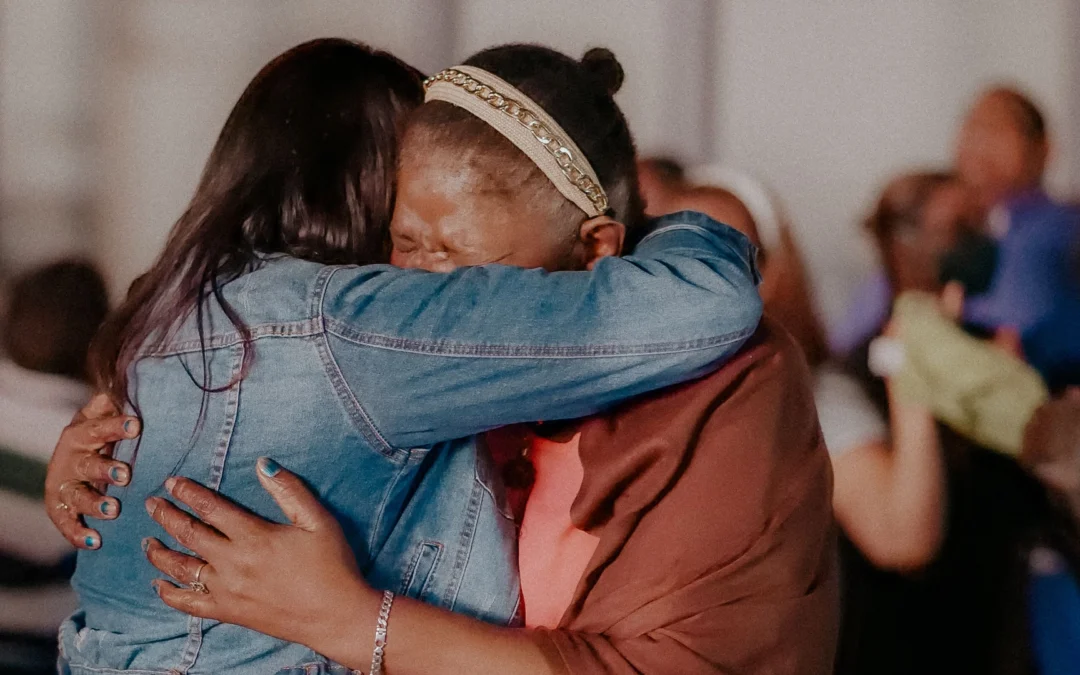
There is something wonderful about a small church. We know one another. We notice when someone isn't there. We know who needs prayer. We know who needs encouragement. We laugh together, sometimes cry together, and increasingly learn to carry one another's burdens.
There are only about twenty-five of us on a typical Sunday. Of course, we want our church to grow. We want new people to encounter Jesus, families to find a spiritual home, and people who have never known Christ to discover the transforming power of the Gospel.
But there is also something we never want to lose – our closeness.
The New Testament describes the Church with many images—the Body of Christ, a flock, a temple, a people belonging to God. But one of its most powerful images is remarkably simple: family.
Paul tells Christians that they are "members of the household of God" (Ephesians 2:19). Peter calls believers "living stones" being built together into a spiritual house (1 Peter 2:5).
Christianity was never intended to be practiced alone.
God takes different people, with different personalities, backgrounds, experiences, and gifts, and builds them together into something none could become individually.
And sometimes those gifts create something beautiful.
The God Who Creates—and Gives Creativity
The Bible begins with creativity.
"In the beginning God created…" (Genesis 1:1)
God could have made a purely functional world. Instead, He made color. Texture. Music. Mountains. Flowers. Sunsets. Human voices. And then He created human beings in His image. Not surprisingly, human beings create too.
In Exodus, when God instructed Israel to build the Tabernacle, He specifically called Bezalel and filled him "with the Spirit of God, with ability and intelligence, with knowledge and all craftsmanship" (Exodus 31:3). Bezalel worked with metals, stone, wood, fabrics, colors, and intricate designs. His artistry was not separate from his service to God.
His artistry was his service to God.
That principle continues in the Church. Some people preach. Some teach. Some cook. Some repair things. Some encourage. Some sing. And some look at a blank canvas and see something the rest of us cannot yet see. Others hear music before a note has been played. Some find words for feelings the rest of us struggle to express. These are gifts too.
Peter reminds us:
"As each has received a gift, use it to serve one another." (1 Peter 4:10)
The gift may differ. The purpose remains the same. Honor God and serve one another.
What Can We Learn from Church History? When Faith and Beauty Met
Walk into many European churches built during the Renaissance and Reformation era and something immediately becomes apparent: Christians believed beauty could communicate. Stone was carved. Windows were filled with color. Choirs filled sanctuaries with music. Biblical stories appeared in paintings, sculpture, woodcuts, and illustrated books.
The relationship between Christianity and art during this period was complicated. Renaissance artists produced extraordinary religious works, while the Reformation raised serious questions about whether religious images could become distractions, or even objects of devotion themselves. Some Reformers removed images from churches. Others embraced visual art while insisting that it remain subordinate to God's Word.
Martin Luther, for example, strongly emphasized Scripture and preaching while being much more receptive to religious images and especially music than some other Reformers. Music became enormously important within Lutheran worship.
Luther reportedly regarded music as one of God's greatest gifts, and the Reformation encouraged congregational singing in ways that profoundly shaped Protestant worship. Meanwhile, the new technology of printing allowed another form of Christian creativity to flourish.
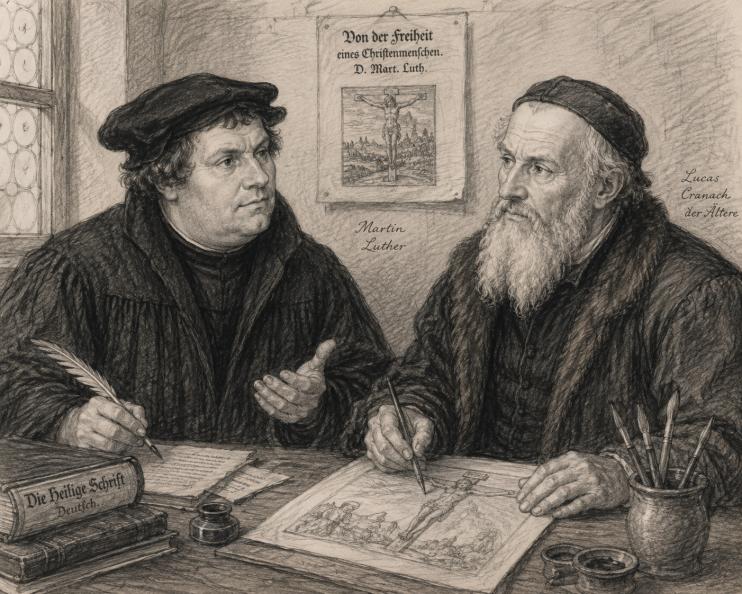
Artists such as Lucas Cranach the Elder, a friend of Luther, produced woodcuts and paintings that communicated biblical and Reformation themes visually. Printers combined words, type, illustration, craftsmanship, and theology to place Christian teaching into the hands of ordinary people.
The Church was discovering again that creativity could serve Christ’s proclamation: A painting could make someone stop and look; a hymn could place theology into someone's memory; a poem could give words to grief; a sketch could illuminate a biblical story. All became, in some way, a beautifully crafted offering to God.
But the Church Is the Work of Art
There is an even deeper lesson here. The most important artwork in a church is not hanging on its walls. It is the people God is forming within it.
Paul writes:"For we are his workmanship, created in Christ Jesus for good works…" (Ephesians 2:10)
The Greek word translated "workmanship" is poiēma, that is, something created or fashioned. It is the word from which our English word poem ultimately derives.
We are God's workmanship. His poetry. His creation. His handiwork.
Twenty-five people gathered in a small church may not look particularly impressive by worldly standards, but imagine what God sees.
- Different colors. Different textures.
- Different stories. Different gifts.
- Different ages. Different personalities.
- Some bold. Some quiet.
- Some musical. Some artistic.
- Some practical. Some deeply compassionate.
- Some still discovering what they have to offer.
God places them beside one another and begins creating something beautiful.
Growing Without Losing the Family
So what happens if twenty-five becomes forty? Or sixty? Or one hundred? We should rejoice. Growth means there are more people to love, more people discovering Christ, and more gifts being added to the family.
However, growth also requires intentionality. The closeness we now experience naturally must eventually become something we choose deliberately to preserve.
- We keep noticing who isn't there.
- We keep sharing meals.
- We keep praying for one another.
- We welcome new people without any distinction between "those of us who have been here for a while" and those who just arrived.
We encourage people to bring their gifts1 with them.
- The musician.
- The painter.
- The poet.
- The carpenter.
- The gardener.
- The teacher.
- The baker.
- The person who quietly notices when someone needs a phone call.
A healthy church does not merely ask: "How many people came?"
It also asks: "Are we becoming a family in which every person has the opportunity to share something they value, their “poetry”?" That may be one of the best measures of growth we have.
From the Church Archives
Lucas Cranach and the Art of the Reformation (1472–1553)
Lucas Cranach the Elder was one of the leading artists of Renaissance Germany and a close friend of Martin Luther. His workshop produced portraits, paintings, engravings, and woodcuts during the turbulent years of the Reformation.
Cranach's work demonstrates something easily forgotten about the Reformation. Although it was fundamentally a movement centered upon Scripture, preaching, and theological reform, its message also spread through music, printing, illustration, craftsmanship, and visual art.
Ordinary Christians encountered theological ideas not only from pulpits but in hymns they sang, books they held, and images they saw.
Why it matters: God has always given His people different gifts. When those gifts are humbly offered to Him, art can become service, beauty can encourage faith, and creativity can help one generation communicate the Gospel to another.
1 In addition, I Corinthians 12:4-11 describes the many different Spiritual gifts, attributes, and skills God provides; I Corinthians 12:7-11 talks about the body of Christ having many members.
For Further Reading
In Scripture
- Exodus 31:1–11 — Bezalel and Spirit-enabled craftsmanship
- 1 Peter 4:8–11 — Loving and serving one another through our gifts
- Ephesians 2:19–22 — Members of God's household
- Ephesians 2:10 — God's workmanship
- 1 Corinthians 12:12–27 — Many members, one body
From Church History
- Martin Luther, writings and sermons concerning music and worship
- Selected works and biblical woodcuts of Lucas Cranach the Elder
- Reformation-era congregational hymns, including Luther's A Mighty Fortress Is Our God
Recommended Books
- Henry Chadwick, The Early Church — for the foundations of Christian community and worship
- Justo L. González, The Story of Christianity, Volume 2 — for the Reformation and the development of Protestant Christianity
- Carlos M. N. Eire, Reformations: The Early Modern World, 1450–1650 — for a broader historical treatment of the religious and cultural world of the Reformation
Faith Through the Ages Timeline
This article begins with the New Testament understanding of the Church as a gifted family and looks especially at Christian creativity during the Renaissance and Reformation.
✓ Apostolic Church (A.D. 30–100)
○ Apostolic Fathers (A.D. 70–150)
○ Ante-Nicene Church (A.D. 150–325)
○ Imperial Church (A.D. 325–590)
○ Early Medieval Church (A.D. 590–1054)
✓ Renaissance & Reformation (approximately A.D. 1400–1648)
○ Evangelical Awakenings (A.D. 1648–1900)
○ Modern Church (A.D. 1900–Present)
Reflection
Look around our church. What has God placed in the people sitting beside you? Perhaps there is a gift we haven't noticed yet. Perhaps there is a poem waiting to be written, a song waiting to be sung, a picture waiting to be painted, a meal waiting to be shared, or a lonely person waiting for someone to sit beside them. Then ask another question:
What has God placed in me that could make our church family stronger?
When God brings new people through our doors, may we make room for their stories and their gifts until they, too, can say:
This is my church. These are my people. This is my family.
Our Commitment to Faithful Adherence to God's Word
We seek to present Scripture as the final authority for faith and practice while drawing upon the best available historical scholarship to help readers understand how Christians have interpreted and lived out biblical truth throughout the centuries. Historical sources illuminate the Church's witness but never supersede the authority of God's Word.