Special Reformation Anniversary Blog
FAITH THROUGH THE AGES: SCRIPTURE & CHURCH HISTORY
Martin Luther: A Troubled Conscience, an Open Bible, and a Church at the Crossroads
October 31, 2026 · 509th Anniversary of the Ninety-Five Theses
“For in it the righteousness of God is revealed through faith for faith; as it is written,
‘The one who is righteous will live by faith.’” — Romans 1:17
A Monk Who Loved His Church
Imagine Wittenberg, Germany, on the last day of October in 1517. Autumn has settled over the little university town, and preparations are underway for All Saints' Day. In the coming years, this otherwise unremarkable town will become one of the most consequential places in Christian history. However, on this particular day, a thirty-three-year-old priest and university professor is concerned about something much more immediate – the spiritual welfare of ordinary Christians.
The monk’s name is Martin Luther.
Luther is not a Protestant. There is no Lutheran Church, no Protestant denomination bearing his name, and no organized movement to divide Western Christianity. He is an Augustinian friar, an ordained Catholic priest, and a professor of biblical theology at the University of Wittenberg. He has devoted his adult life to the Church and understands his calling in thoroughly Catholic terms, yet something troubles him deeply.
Luther has become convinced that certain religious practices are giving Christians a dangerously mistaken understanding of repentance, forgiveness, and their relationship with God. His concerns have grown through years of studying Scripture, hearing confessions, preaching, and wrestling with questions about sin and salvation. He has no intention of becoming the founder of a new Church. He wants the Catholic Church he loves to teach more faithfully what he believes Scripture reveals about God's grace.
On October 31, Luther sends a letter to Archbishop Albrecht of Mainz, enclosing ninety-five propositions written in Latin intended for theological discussion. According to the familiar tradition, he also posts them on the door of Wittenberg's Castle Church, a place used for university announcements and academic topics for discussion. Historians continue to debate whether that dramatic posting actually occurred. What is beyond dispute is that Luther’s theses were circulated, and that they soon spread far beyond Wittenberg through the relatively new technology of printing (i.e., the Gutenberg press). Theories persist that some of his students, seeing the theses in Latin (i.e., intended to more private, academic or internal church discussion), translated the theses into German and initiates broader circulation of Luther’s work.
Within a few years, the consequences would be extraordinary.
Rome, St. Peter's, and the Cost of a Magnificent Church
To understand Luther, we need to travel to Rome.
The Renaissance had transformed the artistic and architectural ambitions of the papacy. Popes commissioned extraordinary works of art, supported scholars, and invested in buildings intended to reflect the grandeur of Christian worship and the historic importance of Rome. The Sistine Chapel, completed in the 15th century, was already a Vatican treasure. Michelangelo finished painting its magnificent ceiling in 1512, but another enormous project was underway: the rebuilding of St. Peter's Basilica. The new basilica would eventually become one of Christianity's most recognizable buildings. Its construction, however, required tremendous financial resources.
One source of funding was an indulgence campaign authorized under papal authority. In Catholic theology, an indulgence concerns the remission of temporal punishment associated with sins whose guilt has already been forgiven. It is not, properly understood, the purchase of God's forgiveness or a substitute for repentance. Nevertheless, the manner in which indulgences were promoted and connected with financial contributions in Luther's day could create precisely those misunderstandings.
The financial arrangements were complicated further by Archbishop Albrecht of Mainz, who had borrowed heavily from a wealthy local family (the Fuggers) to essentially “buy” multiple ecclesiastical offices. An arrangement permitted part of the indulgence revenue to support St. Peter's and part to repay Albrecht's debt.
Luther did not initially know the financial arrangements behind the campaign. His primary concern was pastoral: What were ordinary Christians being led to believe about God's forgiveness?
History of St. Peter's Basilica
From Nero's Circus to St. Peter's Basilica
Long before the magnificent St. Peter's Basilica became one of Christianity's most recognizable landmarks, the surrounding area was associated with the Circus of Nero, an ancient Roman venue for chariot races and other public spectacles. During Nero's persecution of Christians, the circus also became a place of execution. According to early Christian tradition, the Apostle Peter, one of Jesus' original twelve disciples and recognized by the Roman Catholic Church as its first pope, was martyred at that very site around A.D. 64. His remains were reportedly placed in a modest grave within a nearby Roman necropolis, or burial ground.
Around A.D. 319, Emperor Constantine, the first Roman emperor to embrace Christianity, initiated construction of a great basilica over the burial grounds traditionally associated with Peter's tomb. The undertaking was enormous. Construction continued for several decades, with the church substantially completed around A.D. 349. Known to later generations as Old St. Peter's Basilica, it served as one of Western Christianity's most important sacred places for more than eleven centuries.
By the fourteenth century, Constantine's basilica had deteriorated, prompting Church leaders to debate whether the aging structure should be restored or replaced. The question remained unresolved for nearly two centuries as the scale, expense, and historical importance of the building complicated any decision. Finally, in the early sixteenth century, Pope Julius II concluded that extensive repairs would be insufficient and authorized the demolition of the ancient basilica and construction of an entirely new St. Peter's Basilica.
Johann Tetzel and the Promise of an Easier Way
The precise wording and circumstances of Tetzel's use of this slogan are disputed, and Catholic historians have cautioned against treating every account of him as reliable. Nevertheless, Luther's objections to the way indulgences were being preached were genuine, and the controversy soon became public.
Wittenberg did not permit this particular indulgence campaign, but people could travel to neighboring territories where it was permitted.
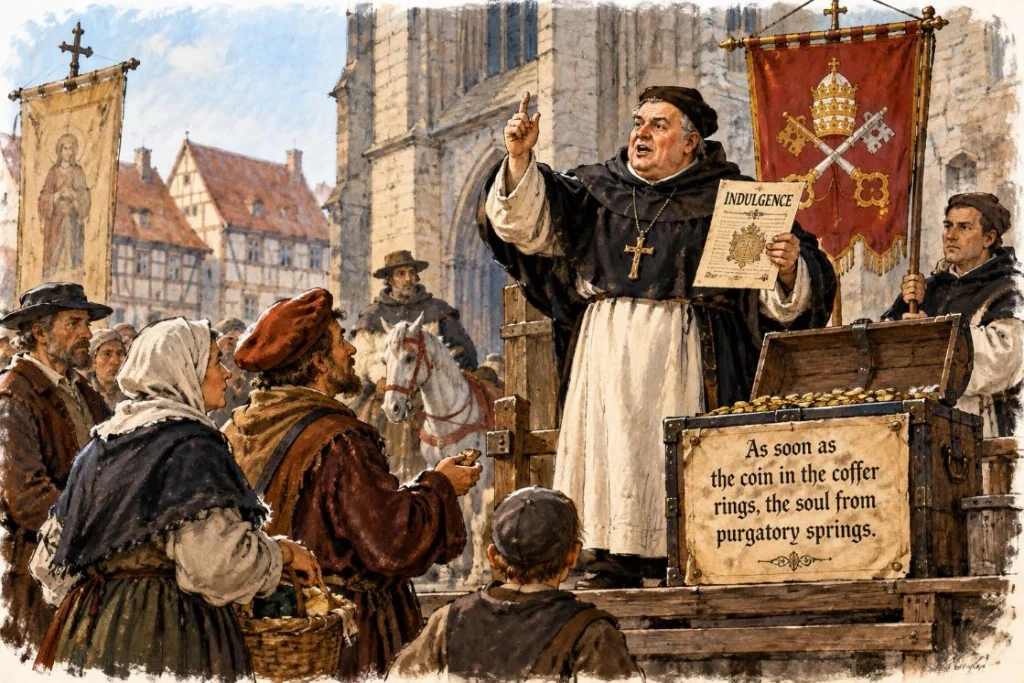
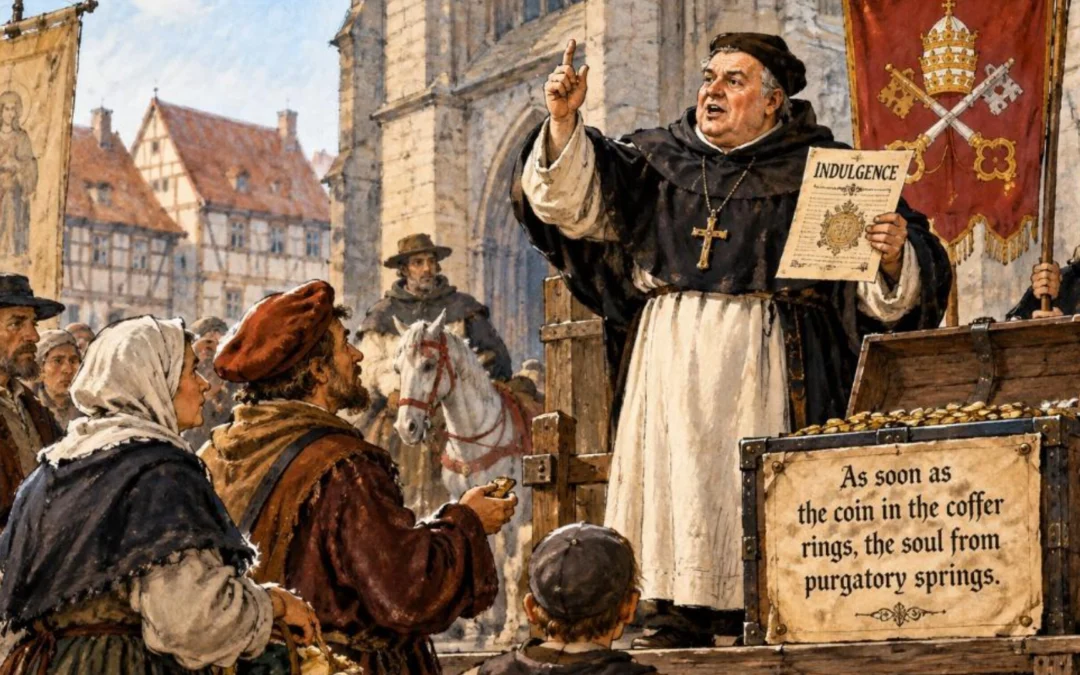
Luther became increasingly concerned that Christians might return from neighboring regions believing that they had purchased an indulgence and – therefore – been resolved from further spiritual obligations. Imagine Luther listening to someone explain that money had been paid to benefit a departed relative in purgatory, or that an indulgence had removed the need for further repentance. How could he reconcile such confidence with Jesus' call to repentance or Paul's teaching that sinners are justified by God's grace through faith? For Luther, this was not merely a dispute about ecclesiastical finances. It concerned the very heart of Christian faith.
As was accepted practice, he draft questions and discussion topics – theses – in Latin for academic and theological review. The first of his Ninety-Five Theses declared that when Jesus called people to repent, He intended the entire life of the believer to be characterized by repentance. Later theses argued that helping the poor was better than purchasing indulgences and that the true treasure of the Church was the Gospel of God's grace. These were objections of a priest who feared that the Church's practices were obscuring the message it existed to proclaim.
Inside Luther's Conscience
To appreciate Luther's actions, we must understand something about the man himself.
Long before 1517, Luther had struggled with a profound awareness of sin and the holiness of God. He entered the Augustinian religious order in 1505 and pursued the spiritual disciplines expected of a serious monk. He prayed, fasted, confessed, studied, and sought to live faithfully, but Luther's conscience remained troubled. He understood that God was righteous. What he struggled to understand was how a sinful person could ever stand confidently before such a God.
Was repentance sufficient? Had every sin been confessed? Could he ever love God as completely
as God's commandments required? How could he know that he had done enough?
His spiritual struggles were intensified by his deeply serious approach to Scripture. We should not imagine that every medieval Catholic shared Luther's anxieties or that Catholic theology simply taught people to earn salvation. Medieval Catholicism possessed a rich theology of grace, and theologians had long debated the relationship between faith, divine initiative, and human cooperation.
However, Luther's own struggle was real. As he studied the Psalms, Romans, and Galatians, he increasingly came to understand God's righteousness through the saving work of Jesus Christ. The believer's confidence rested not upon a flawless record of religious achievement but upon God's gracious promise in Christ. Romans 1:17 became particularly important in Luther's later account of his theological development. He described coming to understand the righteousness revealed in the Gospel as God's gracious gift, received through faith.
The precise chronology of this insight—sometimes called Luther's tower experience—remains debated. It should not be presented as though everything suddenly became clear to him on one particular afternoon; his theological understanding developed over time. However, the direction was unmistakable:
Luther was discovering that the Christian life begins not
with our ability to satisfy God through our own
achievements, but with God's mercy toward us in Christ.
That conviction helps explain why the indulgence campaign troubled him so deeply. If God's grace is central to salvation, how could Christians be encouraged to place their confidence in a purchased certificate? If repentance involves the whole Christian life, how could it be reduced to a transaction?
Luther feared that people were being offered religious reassurance without being led into a deeper relationship with Christ.
Luther's Tower Experience: Discovering Grace
While studying Romans 1:17, Luther struggled to understand how a sinful person could stand righteous before a holy God. He later described a profound realization that the righteousness revealed in the Gospel is God's gracious gift, received through faith rather than earned through human achievement. Traditionally called his Tower Experience, this insight developed within a longer period of theological study, and historians continue to debate precisely when it occurred.
The Ninety-Five Theses: A Request for Debate That Became a Revolution
The Ninety-Five Theses were originally written in Latin, the language of academic theology. They were propositions for debate, not a fully developed manifesto of Protestant doctrine. That distinction matters.
In 1517, Luther had not yet reached all the conclusions that would later define his theology. He had not abandoned every traditional understanding of papal authority, nor had he formulated the mature Reformation teaching on justification in all its later detail. His challenge began with indulgences, repentance, and the responsibilities of Church leaders, yet questions he raised proved impossible to contain.
If the pope's authority over indulgences was limited,
what were the limits of papal authority more generally?
If Scripture taught something different from prevailing ecclesiastical practice, which should govern?
And if salvation rested upon God's grace through faith,
how should the Church understand its sacramental
and pastoral responsibilities?
As Luther's writings circulated, theologians and Church authorities challenged him. The controversy expanded from indulgences to authority, Scripture, justification, and the nature of the Church itself. In 1520, Pope Leo X formally condemned a number of Luther's propositions and called for their retraction.
The Diet of Worms (1521):
A Matter of Conscience
Summoned before Emperor Charles V and the imperial assembly at Worms, Germany, Martin Luther was ordered to retract his writings. He refused unless persuaded by Scripture or sound reason, declaring that his conscience was bound by the Word of God. The famous concluding words, “Here I stand, I can do no other,” are traditionally attributed to Luther, although their presence in his actual speech is historically uncertain.
Luther refused, and he was excommunicated in January 1521. Later that year, at the Diet of Worms, he was pressed to retract his writings before imperial authorities. The division was becoming irreversible. What began as a call for theological debate had become a confrontation that would transform Western Christianity.
A Turning Point—But Not a Simple Victory
From a Protestant perspective, the Reformation restored essential biblical truths to greater prominence, particularly the authority of Scripture and justification through faith in Jesus Christ. It encouraged renewed attention to biblical preaching, congregational participation, Christian education, and the translation of Scripture into languages ordinary people could understand.
However, the Catholic Church contained many devoted Christians, serious theologians, and reform-minded leaders. Christianity survived for 1,500 years because of God’s work through the Catholic church and its stewardship of the mantel placed upon it. Catholic renewal was already underway before Luther, and the upheavals of the sixteenth century productively contributed to further reforms, especially through the Council of Trent (1545–1563). The Catholic Church addressed abuses, strengthened clerical formation, and reaffirmed teachings it believed essential to Christian faith
The Reformation was not simply a story of courageous reformers, nor did the Reformation produce only beneficial consequences. Western Christianity fractured into competing confessions. Political and religious conflicts contributed to persecution, violence, and enduring divisions among Christians.
In addition, Luther himself was a deeply imperfect man. He could be remarkably courageous and spiritually perceptive, but also combative, harsh, and intolerant. His later writings against Jews contained hateful and dangerous arguments that Christians should unequivocally reject. His treatment of opponents, including other reformers, sometimes contradicted the humility and charity that the Gospel requires. These failings are not incidental details to be excused because of his theological achievements. They remind us that even influential Christian leaders remain accountable to the teachings of Christ.
We can recognize Luther's extraordinary contribution without turning him into a flawless hero. We can respect the Catholic Church's enduring Christian witness without denying the serious abuses that helped precipitate the Reformation.
Perhaps the most constructive way to remember October 31, 1517, is not as a celebration of one Christian tradition's victory over another, but as an occasion to ask what happens when Christians take Scripture, repentance, and their relationship with God seriously.
Wartburg Castle (1521–1522): A Refuge That Changed Christianity
In April 1521, Martin Luther stood before the Diet of Worms and refused to retract his writings unless persuaded by Scripture and sound reason. His defiance placed him in grave danger, particularly after Emperor Charles V issued the Edict of Worms, declaring him an outlaw. The danger was especially poignant given the fate of John Hus, who, just over a century earlier, had traveled to the Council of Constance under a promise of safe conduct, only to be imprisoned, condemned for heresy, and burned at the stake in 1415. Luther's protector, Frederick the Wise, Elector of Saxony, was determined that history would not repeat itself. On May 4, 1521, while Luther was returning from Worms, Frederick's supporters staged a dramatic kidnapping and secretly transported him to Wartburg Castle near Eisenach. There, disguised as a minor nobleman named Junker Jörg (“Knight George”), Luther remained hidden for approximately ten months.
What appeared to be an interruption of Luther's ministry became one of its most consequential chapters. During his confinement, Luther translated the New Testament from Greek into German, making Scripture more accessible to ordinary Christians and helping shape the development of the German language. His translation was published in September 1522, several months after he left Wartburg. There is a remarkable historical contrast between Hus and Luther: one reformer was executed for his convictions, while another, facing similar dangers a century later, found protection and continued his work. The connection recalls the famous, though historically unverified, prophecy attributed to Hus: “Today you burn a goose, but in a hundred years a swan will arise whom you will not be able to silence.” Whether or not Hus ever spoke those words, the enduring influence of both men reminds us that the consequences of faithfulness may extend far beyond the circumstances of our own lives—and sometimes beyond our lifetimes.
Five Centuries Later: An Unexpected Reconciliation
There is another chapter in this history that deserves attention, particularly because it is less familiar to many Protestants.
On October 31, 1999—exactly 482 years after Luther's Ninety-Five Theses—the Roman Catholic Church and the Lutheran World Federation signed the Joint Declaration on the Doctrine of Justification in Augsburg, Germany.
After decades of theological dialogue, the two traditions declared that they had reached a consensus on basic truths concerning justification through God's grace and faith in Christ. This did not erase every doctrinal difference or reunite the churches institutionally. Questions concerning Church authority, ministry, sacraments, and other theological matters remain, but it represented an extraordinary development in a dispute that had helped divide Western Christianity for nearly five centuries.
Think about that for a moment.
A controversy that began with a troubled priest asking whether Christians properly understood God's grace eventually became the subject of renewed work between Christian communities for centuries separated from one another. That reconciliation does not require
The Joint Declaration (1999): Finding Common Ground
On October 31, 1999, the Roman Catholic Church and the Lutheran World Federation signed the Joint Declaration on the Doctrine of Justification in Augsburg, Germany. After centuries of division, both affirmed a shared understanding of fundamental truths concerning salvation by God's grace through faith in Christ. Although important theological differences remain, the agreement marked a remarkable milestone in Christian reconciliation.
either tradition to abandon its convictions. It demonstrates that serious Christians can examine their differences honestly while recognizing the faith they share in Jesus Christ. Perhaps it brings us back to something Luther himself desperately wanted in 1517 – a Church that would help people understand the Gospel more clearly and walk more faithfully with God.
What Would Luther Want Us to Remember?
We cannot know precisely what Luther would say if he could visit our churches today. Five centuries of theological development, cultural change, and denominational history separate us from his world. However, we can think about the concerns that animated his early ministry. For example, he wanted Christians to understand repentance as more than a religious transaction. He wanted them to take Scripture seriously. He wanted them to recognize their dependence upon God's grace. He wanted the Church's teaching and pastoral practices to direct people toward Christ rather than provide misplaced confidence in outward religious accomplishments.
Those concerns remain relevant regardless of whether someone worships in a Catholic, Lutheran, Methodist, Baptist, Pentecostal, or nondenominational congregation.
Do we know what Scripture actually teaches, or do we simply accept what we have always heard?
Does our participation in worship deepen our relationship with Jesus Christ, or have
we become satisfied with familiar religious routines?
Are we helping people understand God's grace, or unintentionally suggesting that
Christian faith is principally a matter of measuring up?
Do our churches encourage sincere repentance, spiritual growth, love, and service?
Perhaps most importantly, are we willing to examine our own assumptions when
Scripture challenges them?
Luther's story reminds us that the Church must continually return to its foundation. Not because every tradition is wrong, or every longstanding practice should be abandoned, but because the Church belongs to Jesus Christ, and its life must remain centered upon Him.
The Door That Still Stands
Visitors to Wittenberg today can stand before the Castle Church and see the Ninety-Five Theses inscribed upon its [now] bronze doors. The original wooden doors were destroyed in the eighteenth century. They are an impressive reminder of an extraordinary moment in Christian history, yet the lasting importance of October 31, 1517, does not depend upon whether Martin Luther actually carried a hammer to those doors. The importance lies in the questions he raised.
What is genuine repentance? What is the source of our confidence before God? What
authority should guide the Church? How do we distinguish God's gracious gift from
the religious practices through which Christians seek to express their devotion?
Those questions still matter, and they bring us back to the Apostle Paul, whose words have guided our recent series on living by faith:
“The one who is righteous will live by faith.” — Romans 1:17
With the recent blogs, we spent several weeks considering what that means. Faith brings us into a right relationship with God through Jesus Christ. Faith opens our lives to the transforming work of the Holy Spirit; living faith becomes visible through love, forgiveness, generosity, and service.
Luther's life reminds us that those truths are not merely subjects for theological debate. They concern the way ordinary Christians understand God and live. He did not foresee the enormous movement that would eventually bear his name, nor could he have anticipated all the divisions, reforms, controversies, and renewals that followed. He understood – though – that something essential was at stake.
Perhaps the most fitting way to remember the 509th anniversary of the Ninety-Five Theses is not to ask whether we would have stood beside Luther in Wittenberg. Maybe it is to ask whether we possess the same willingness to examine our faith, open our Bibles, acknowledge our need for grace, and allow Jesus Christ to draw us closer to Himself.
Five hundred and nine years later, the question is not simply what Martin Luther
believed. It is whether we are learning to live by faith ourselves.
Historical Sources and Further Reading
For this extended blog, I recommend a more substantial reading section than our usual brief bibliography. These sources offer different perspectives, including Protestant, Catholic, and secular historical scholarship.
Martin Luther, Disputation on the Power and Efficacy of Indulgences (1517). The Ninety-FiveTheses themselves. An annotated English translation is available through Oxford University's digital edition.Timothy J. Wengert,Martin Luther's Ninety-Five Theses: With Introduction, Commentary, andStudy Guide. Particularly useful for understanding what Luther actually argued in 1517, rather than reading later Protestant doctrine back into the document.Lyndal Roper, Martin Luther: Renegade and Prophet. A major modern biography that exploresLuther's personality, spiritual struggles, theological development, and complicated legacy. Her later essays in Living I Was Your Plague are especially useful for critical evaluation.Peter Marshall, 1517: Martin Luther and the Invention of the Reformation. Particularlyvaluable for separating the historical events of 1517 from the legends and commemorative traditions that developed afterward.Peter M. Folan,Martin Luther and the Council of Trent: The Battle over Scripture and theDoctrine of Justification. A scholarly Catholic perspective that examines the substantive theological disagreements between Luther and the Council of Trent, rather than reducing the conflict to abuses or misunderstandings.Isaac Kalimi, “The Position of Martin Luther toward Jews and Judaism” (2023). A criticalscholarly examination of an important and troubling aspect of Luther's legacy.Roman Catholic Church and Lutheran World Federation,Joint Declaration on the Doctrine ofJustification (1999). An important primary document demonstrating how the two traditions have approached their historical theological differences through contemporary dialogue. Read the declaration at the Vatican website.
Wartburg Castle, near Eisenach, Germany. Following the Diet of Worms in 1521, Martin Luther was secretly brought here for his protection. During his approximately ten-month stay, he translated the New Testament into German, helping make Scripture more accessible to ordinary Christians.
Photo credit: Krzysztof Golik / Wikimedia
Commons / CC BY-SA 4.0.